Data-led Article
The Hidden Cost of Manual Order Processing in B2B
Most operations teams know manual order processing takes time. Few have actually counted what it costs. Here's what a typical day looks like — and what it adds up to.
|
Alex
|
|
~6 min
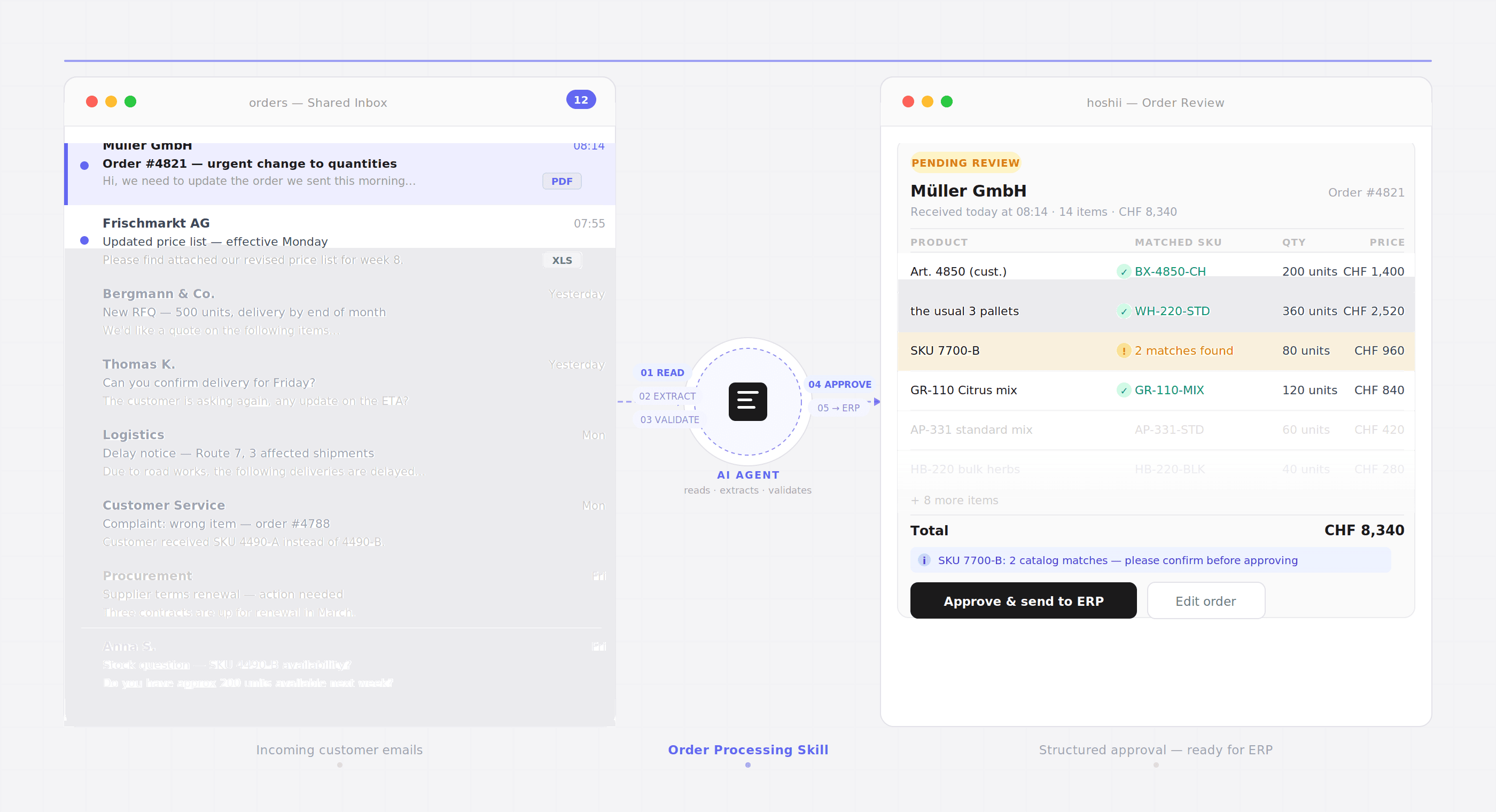
Take a single order. A customer emails a PDF. Fourteen line items, their product codes, not yours. Someone on your team opens the email, opens the ERP, and starts typing. They cross-reference the customer’s price list. They check stock. They enter each line. They send a confirmation back.
Twenty minutes, if everything goes smoothly. More if the PDF is scanned at an angle, or if two of the article numbers don’t match your catalog, or if the customer’s usual contact is out and nobody is sure which price tier applies.
Now multiply that by the number of orders your team processes in a day. Then a week. Then a month.
For most B2B operations teams, manual order processing isn’t an edge case — it’s the job. And the cost of doing it that way is almost never properly measured, because it’s woven into every hour of every working day.
The most expensive operational problems are the ones that feel normal.
What the time actually looks like
A realistic breakdown for a mid-sized wholesale or distribution operation processing orders manually looks something like this.
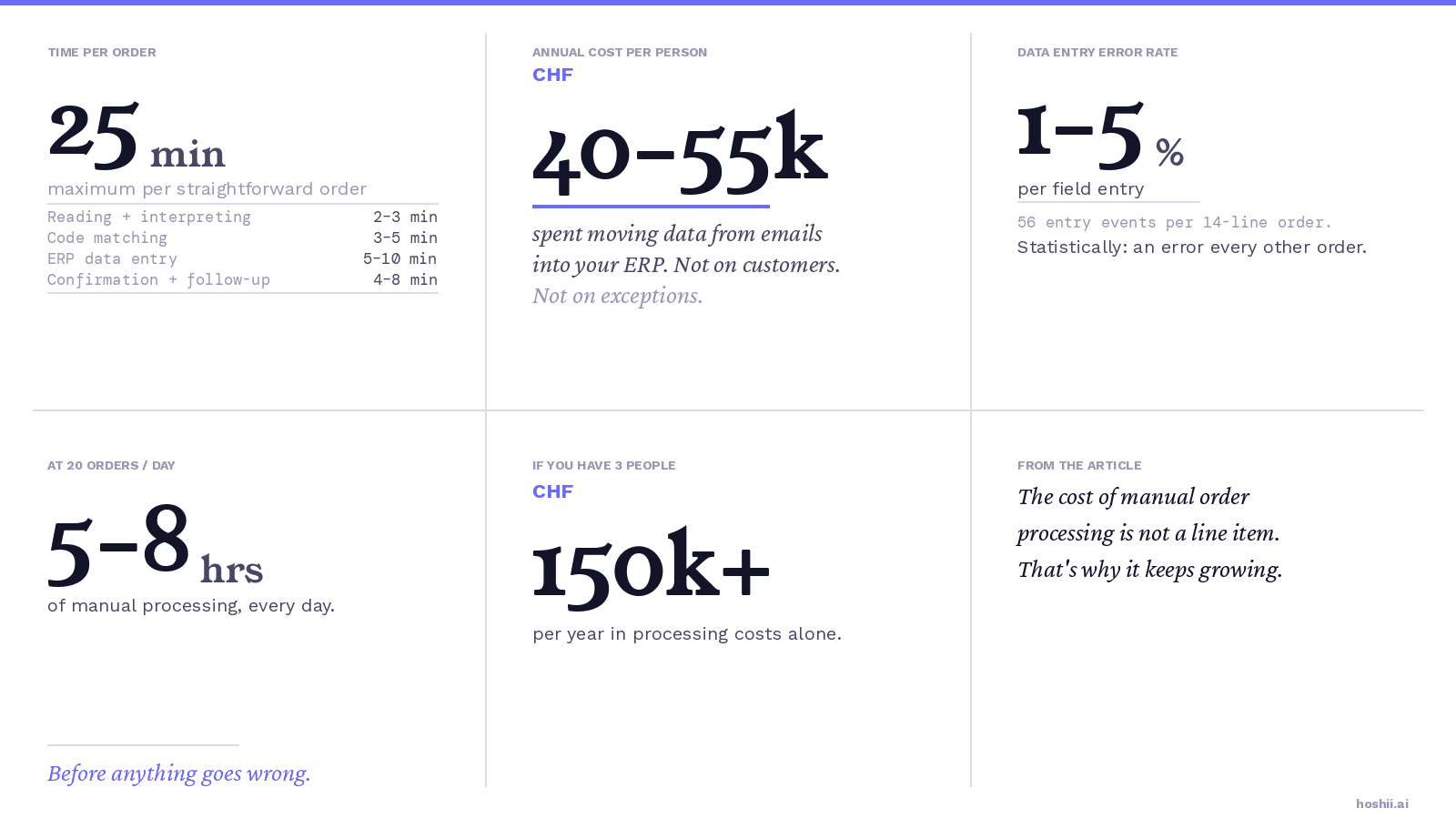
Reading and interpreting the email takes two to three minutes per order. This sounds trivial but it isn’t — orders arrive in different formats, with different levels of clarity, from customers who each have their own habits and shorthand.
Cross-referencing product codes takes another three to five minutes. Your customer calls it “Art. 4850.” Your ERP knows it as “BX-4850-CH.” Someone has to bridge that gap every single time, usually by memory or by scrolling through a lookup sheet that lives in a shared Excel file nobody has updated since 2021.
Manual entry into the ERP takes five to ten minutes depending on order length. This is the part that feels most like work — and it’s also where most errors happen. A transposed digit. A quantity entered on the wrong line. A delivery date that defaults to today instead of next Thursday.
Confirmation and follow-up adds another two to five minutes. Writing the confirmation email, attaching whatever the customer expects, sending it, then fielding the reply that asks why line 7 shows a different unit price than last month.
In total: fifteen to twenty-five minutes per order, for a straightforward case. Complex orders, new customers, or anything arriving as a scanned document can push that to forty-five minutes or more.
At twenty orders a day, that’s between five and eight hours of manual processing. Every day. Before anything goes wrong.
What goes wrong — and how often
Manual data entry has a well-documented error rate. Studies across industries consistently put it at between one and five percent per field entry. In a fourteen-line order with four fields per line, that’s fifty-six data entry events. Even at one percent, you’d expect an error roughly every other order.
In practice, B2B operations teams catch most errors before they become problems. But catching errors has its own cost. It requires someone to notice, investigate, and correct — often in the ERP, sometimes in a confirmation already sent to the customer, occasionally after a shipment has already left the warehouse.
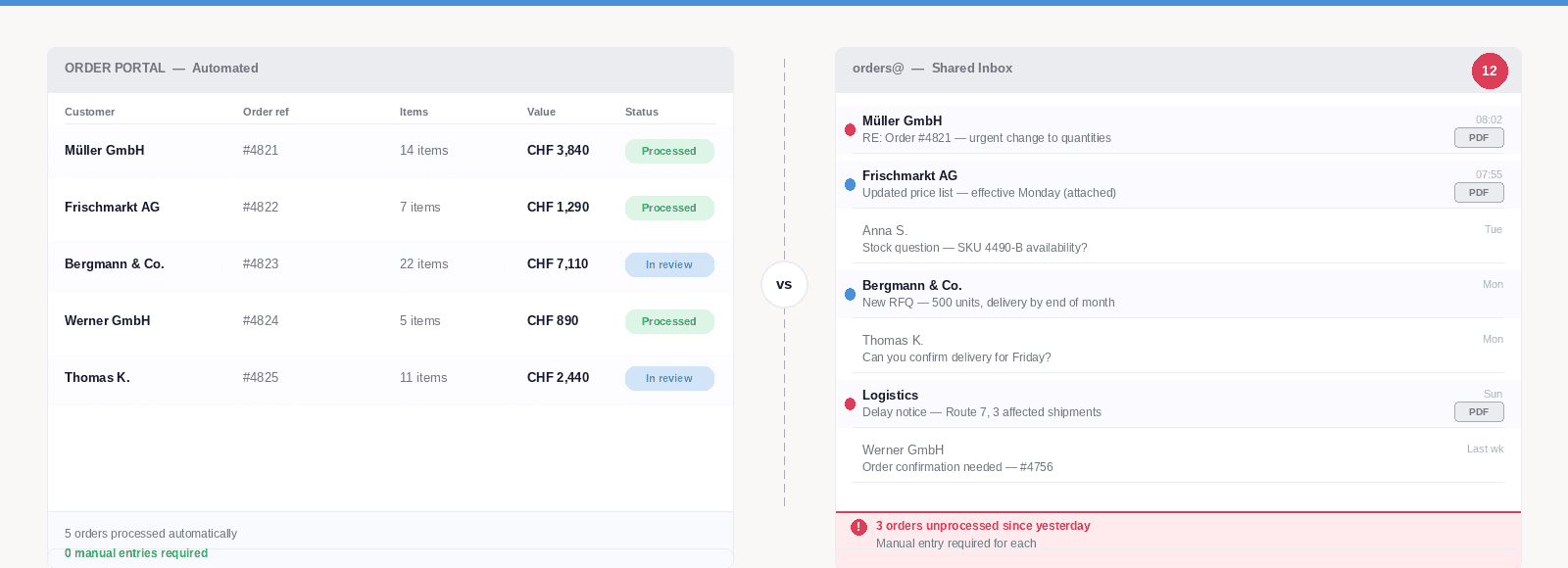
The errors that slip through are the expensive ones. A wrong quantity ships. A discontinued product gets ordered. A customer receives goods at last year’s price because the price list update didn’t make it into the right lookup table in time.
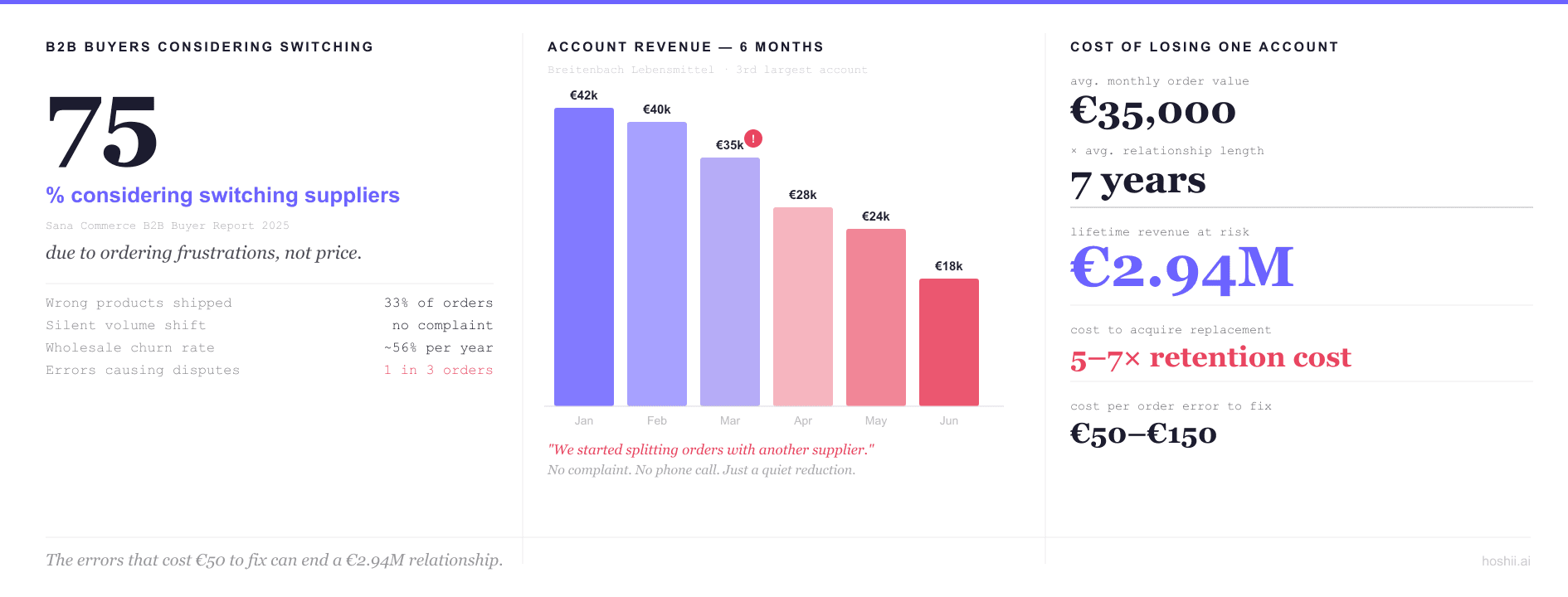
Each of these has a direct cost — returned goods, credit notes, emergency reshipments. And an indirect cost that doesn’t show up on any report: the customer who quietly decides that your operation is too unreliable and starts looking at alternatives.
The staffing math nobody does
Here is a calculation most operations leaders have never run explicitly.
Take an operations coordinator. Fully loaded cost — salary, taxes, benefits, office — somewhere between CHF 80,000 and CHF 110,000 per year in Switzerland. Divide that by 220 working days, then by eight hours. You get a rough hourly cost of CHF 45 to CHF 62.
If that person spends four hours a day on manual order processing, you are spending between CHF 180 and CHF 250 per day — CHF 40,000 to CHF 55,000 per year — on a task that is entirely about moving information from one place to another. Not on customer relationships. Not on exception handling. Not on the things that actually require a person.
And that’s one person, handling one inbox. Many operations teams have two or three people doing variations of this work across customer orders, supplier communications, and everything in between.
The cost of manual order processing is not a line item anywhere. That’s precisely why it keeps growing.
The compounding problem
What makes this particularly difficult to address is that the cost compounds over time without anyone deciding it should.
As the business grows, order volume grows. More orders means more processing time. The team gets busier. Response times slip slightly. Errors increase slightly. A second person gets hired to help with the load. The cost doubles. Nobody questions whether the underlying process should change — the assumption is that more volume requires more people, and that’s just how operations works.
The teams that break this pattern are not necessarily the ones with the best technology. They’re the ones that at some point actually measure what manual processing costs them — in hours, in errors, in staff time — and decide that the answer is not another hire.
What “fixing it” actually means
The goal is not to eliminate human judgment from order processing. That judgment is genuinely valuable — for exceptions, for customer relationships, for the cases where something doesn’t add up and a person needs to decide what to do.
The goal is to remove the human from the parts that don’t require judgment. Reading a PDF. Matching an article number. Entering a quantity. Sending a standard confirmation. These are not tasks that benefit from human involvement — they benefit from human oversight, which is different.
The operations teams getting this right are the ones treating order processing the way they’d treat any other repeatable operational task: defining what “correct” looks like, building something that handles the routine cases reliably, and keeping their people focused on the work that actually requires them.
The honest starting point
Before changing anything, it helps to know what you’re actually dealing with. How many orders does your team process manually per day? How long does each one take, realistically? Where do errors most commonly occur? How much of your team’s time is going to processing versus judgment?
Most operations teams have never formally answered these questions. The numbers exist — in timesheets, in error logs, in the quiet knowledge of the people doing the work — but they’ve never been pulled together into a clear picture.
That’s the starting point. Not a new system, not a new hire. Just an honest count of what the current approach actually costs.
Download the checklist: [Checklist-Link]
We’ve put together a short checklist to help you run that count for your own operation. It covers the key metrics worth tracking, the questions worth asking your team, and the calculations that will give you a realistic picture of what manual order processing is costing you today.
Next week: what actually changes when an AI agent starts handling your inbound orders — and what your team’s role looks like when it does.